
In February 2025, the Isipathana family pauses to mark a milestone that every Isipathanian, past and present, carries with deep pride. Seventy-four years since a school was born in a coconut grove in the heart of Colombo. Seventy-four years of striving with determination. Seventy-four years of building something extraordinary from the humblest of beginnings.
This is the Isipathana story, and it belongs to every single one of us.
It all started in January 1952. Four hundred boys, the overflow from Royal Preparatory School, were given a new home on a seven-acre patch of land along Greenlands Road in Havelock Town. The coconut groves and lush greenery that surrounded the site gave the school its first name. Greenlands College.
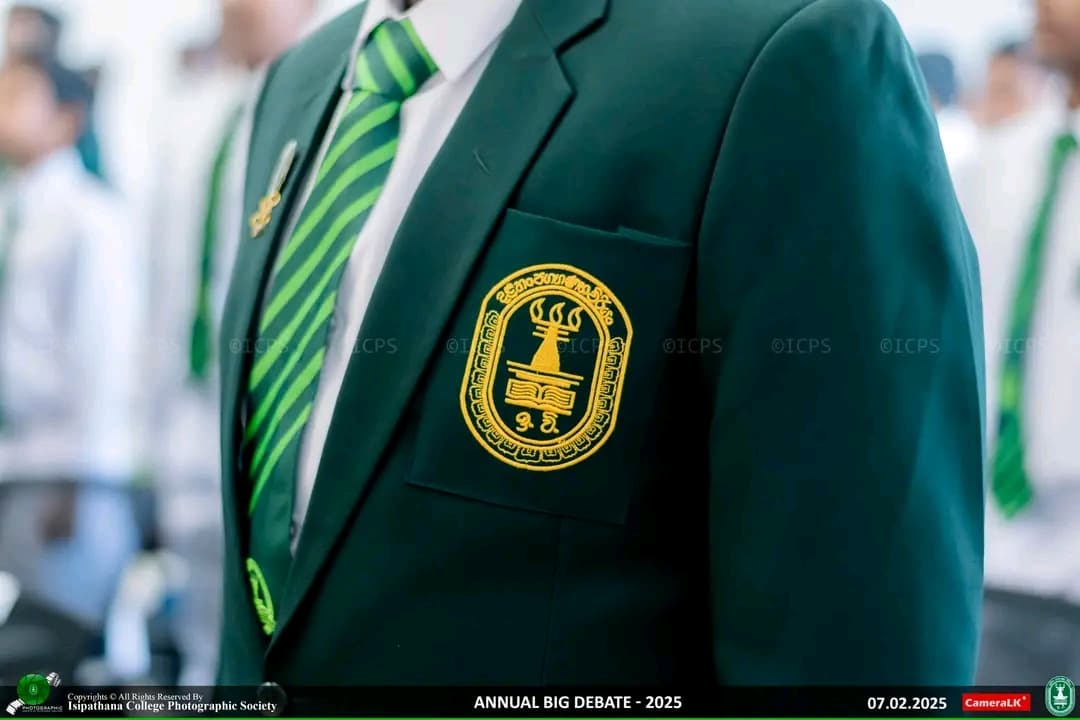
The first principal, Mr. B.A. Kuruppu, walked through those gates with just seven teachers and a vision that would outlast them all. Classes were organised in all three streams, Sinhala, Tamil, and English, establishing from day one the multilingual and inclusive identity that Isipathana carries to this day. The college crest was designed with the assistance of Mr. J.D.A. Perera and Mr. Stanley Abeysinghe of the Heywood School of Art. A lighted lamp, an open book, and the motto that still echoes through every corridor and every playing field. “Strive with determination.”
The first sports meet was held in March 1953. The first prize giving followed in 1954, along with the first issue of the college magazine. Even in those earliest years, the ambition was clear. This was not going to be an ordinary school.
In 1956, the Vihara Mandiraya and Chaitya were built on the school premises to commemorate the Buddha Jayanthi year. As the country underwent sweeping socio-cultural changes, the school adapted with it. Greenlands Road was renamed Isipathana Mawatha after the nearby Isipathanaramaya Temple, and on 2nd May 1961, Greenlands College officially became Isipathana Maha Vidyalaya.
Within a decade, Greenlands had become Isipathana. A new name, but the same green heart beating underneath.
The college grew rapidly. In 1962, it was divided into Kanishta (junior) and Jeshta (upper) Vidyalayas with two separate principals to manage the expanding student body. The Education Department amalgamated the two divisions back into one in 1975, and in 1999, the school was unified under a single principal as Isipathana College. Today, the campus stretches across 4.5 hectares with over 7,500 students walking through those gates every morning. From 400 boys in a coconut grove to one of the most respected national schools in Sri Lanka.
No article celebrating Isipathana’s legacy would be complete without talking about the sport that put the green jersey on the map. Rugby at Isipathana began in the early 1960s when the school’s first official team took to the field, coached by Y.C. Chang and captained by Bryan Ingram. The seed had been planted years earlier by Mrs. Geddes, an English teacher and rugby fanatic whose passion for the game inspired a generation.
What followed over the next six decades is nothing short of remarkable. Sixteen league championships. Thirteen President’s Trophy Knockout titles, the most by any school in the tournament’s history. Eighty-four players have worn the Sri Lanka national jersey after learning their craft in the green of Isipathana. The college became the first school in Sri Lanka to achieve the triple championship, a feat that earned the team the nickname that every rugby fan in the country knows. The Green Machine.
From the legendary sides of the 1980s and 1990s that dominated the schools rugby landscape, to the unbeaten league champions of 2022 and the back-to-back President’s Trophy winners of 2024 and 2025, the tradition of excellence on the rugby field has never wavered. Annual encounters like the Major Milroy Fernando Trophy against Royal College and the Abdul Jabbar Trophy against traditional rivals Thurstan College remain among the most anticipated fixtures on the schools rugby calendar.
In 2024, the college reached another milestone when Henry Pedris Stadium in Havelock Town was officially handed over to Isipathana through a cabinet decision. After decades of playing on borrowed grounds, the Green Machine finally has a home.
While the Green Machine captures the headlines, Isipathana’s achievements reach far beyond the rugby field. The Battle of Brothers cricket encounter against Thurstan College has been a fixture since 1963, with over 57 matches played in a rivalry steeped in tradition and sportsmanship. Football, hockey, swimming, karate, basketball, athletics, cadetting, and scouting all thrive within the college, offering students pathways to excel in whatever discipline calls to them.
Academically, Isipathana has consistently produced outstanding results. The college recorded one of its best ever performances at the Grade 5 scholarship examination in 2024, achieving the best results among schools in Colombo South with 89.93 percent of students scoring above 70 marks. At the G.C.E. Ordinary Level, a 92.5 percent success rate saw 309 out of 334 students qualify for Advanced Level studies. The completion of a new five-storey Advanced Level Science Complex in 2024, funded by a distinguished old boy, signals that the investment in academic excellence is only accelerating.
Isipathana was also a pioneer in ways that many may not know. The first school in Sri Lanka to publish a periodical children’s newspaper with a student-only editorial board. The first to offer Japanese language and culture from grade two onwards. The first to produce a Test cricketer who took Sri Lanka’s first hat trick. The first to develop a website for a UN organisation, UNICEF Sri Lanka, built entirely by its students. The first to produce a documentary of the school on CD. The school that produced the first Sri Lankan appointed by the International Rugby Board as Referee Trainer for the Asian Region.
These are not just records. They are a reflection of a school culture that has always encouraged its students to think bigger, reach further, and do what has not been done before.
From the very beginning, Principal Kuruppu established a house system that would become central to the Isipathana identity. The four houses are named after four great poets from different cultures. Thotagamuwe Sri Rahula Thera, Rabindranath Tagore, John Milton, and Muhammad Iqbal. It is a choice that says everything about what Isipathana has always stood for. A school built on diversity, where Sinhala, Tamil, and English-speaking students, and students of every faith, compete and grow together under one roof.
The annual inter-house sports meet, which dates back to the very first years of the college, remains one of the most passionately contested events on the school calendar.
The Isipathana College Old Boys’ Association, originally formed in 1960 and formally reorganised in 1982, has been the backbone of the college’s growth over the decades. From funding new buildings and renovating facilities to supporting scholarships and sports programmes, the OBA has ensured that the progress never stops. Distinguished old boys have gone on to serve in government, lead in business, excel in academia, and represent the nation on sporting fields around the world.
And then there is the ICOIC. What began as a Facebook group connecting Isipathanians and fans online has grown into one of the strongest school communities on social media, eventually expanding to IsipathanaOnline.info as a hub for news, history, and everything green. This community is proof that the bond between Isipathanians does not fade with time. It only grows stronger.
As we celebrate this milestone in February 2025, it is worth stepping back and appreciating just how far we have come. From 400 boys and seven teachers in a coconut grove to over 7,500 students on a campus that is continuously evolving. From a friendly rugby match on a borrowed field to sixteen league titles and a home ground of our own. From a school magazine printed in 1954 to a vibrant online community that connects Isipathanians across the globe.
The motto has never changed. Strive with determination. And for seventy-four years, that is exactly what every student, teacher, principal, old boy, parent, and supporter of Isipathana College has done.
Here is to the next seventy-four.
Happy anniversary, Isipathana. The ICOIC family celebrates with you, today and always.
Isipathana College delivered a dominant performance in their highly anticipated T20 “Battle...
READ MORE
Isipathana College booked their place in the semi-finals of the Dialog Schools...
READ MORE
UUDS Tuskers emerged as standout performers at the opening leg of the...
READ MORE